A few years ago I took on a client who needed a ground-up rebuild. Their platform was outdated, their site was overdue for a modernization, and the opportunity was real: start fresh, do it right, build something that would serve them for the next decade.
Ten months later, we were done. It should have taken three.
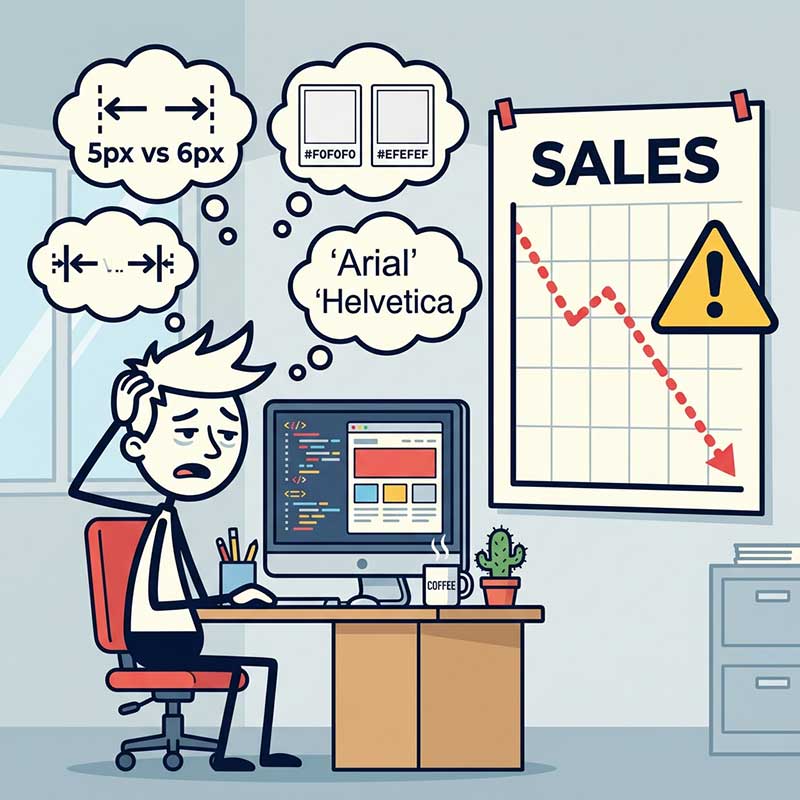
The extra seven months weren't spent on hard technical problems. They were spent on things like whether a navigation menu sat 5 pixels higher or lower than it did on the old site. On whether a button color matched the button color from 2004. On eight nearly-identical link colors across eight different pages that no one but the site owner would ever notice.
There was also the responsive design problem. When a site is built responsively — which is to say, built for 2026 — the layout shifts as the screen gets smaller. That's the point. But every shift felt like an error to be corrected, a pixel here, a pixel there, things customers never notice.
Meanwhile, real work waited in the wings, begging for attention. Product descriptions were thin. Navigation made it hard to find things. The checkout had rough edges that real customers were hitting.
I'm not here to criticize this client. They're not alone — they're just the clearest example of a pattern I've seen many times. And the pattern has a name.
It's cleaning the kitchen instead of generating sales.
The Kitchen Problem
Every business owner knows the feeling. The kitchen is spotless, the inbox sorted, the files labeled — and the thing that was supposed to happen didn't happen.
Every hour spent debating a hover state is an hour not spent on something that actually drives revenue.
Here's something I've said to clients more than once:
Nobody has ever added something to their cart because your menu was 5 pixels higher than it used to be.
That's not an argument for sloppy work. It's an argument for proportion.
What Actually Costs You Sales
There's a short list of things that genuinely keep people from buying:
- A checkout flow with a confusing or broken step
- Page load times that test a user's patience
- Product descriptions that don't answer the questions a buyer has at the moment of decision
- Navigation that makes it hard to find the thing someone came to buy
- No clear answer to: why should I buy this from you instead of someone else?
- Information overload / compressed display: Really, it's OK if the customer needs to scroll down.
Notice what's not on that list. The hover state. The font on the FAQ page. The exact pixel position of a header. The color of a link that 95% of visitors will never consciously register.
The work that drives sales is creating conditions where someone who wants your product can find it, understand it, trust you, and complete the transaction without friction.
Where Your Energy Actually Belongs
Here's where the return on your investment is highest:
Product content. Are your descriptions answering the questions a real buyer has right before they pull the trigger? Compatibility, sizing, use case, what makes yours different from the generic version. This is also the highest-leverage SEO work you can do — and it's work only you can do well. You know your products.
Navigation and product organization. Can someone who doesn't already know your catalog find what they're looking for? Miva Merchant gives you powerful tools for category structure and navigation, but those tools only work if the organization makes sense to a customer, not just to you.
Competitive intelligence. There's nothing wrong with regularly visiting your competitors' sites and taking notes. What are they doing well? What are they missing that you could own? What are customers saying in reviews — theirs and yours? That's free market research.
Customer relationships. The repeat customer is the most valuable customer and the most underinvested one. Email, follow-up, loyalty all compound over time in ways that a polished About page simply doesn't.
Your Website Is Never Finished
And that's fine. That's what phase 2 is for.
There will always be something that could be improved, a feature that could be added, a section that could be rewritten. Working on SEO every day like it's a habit. Updating product descriptions as your inventory evolves. If you're waiting for the site to be finished before you launch (or before you feel good about it) you're going to wait a long time.
More to the point: if you wait until your site is "finished" you've already lost customers.
Launch when it's ready, when everything works. Then keep going. The goal isn't a finished website, websites are never finished. The goal is a website that sells. Your developer is like your car mechanic who keeps you going, keeps things running smooth, while your attention stays on the things that actually grow the business.
Trust Your Developer
A developer who's been in this business long enough has seen every version of the kitchen-cleaning pattern. We've sat in the zoom meetings, been on the email threads, watched hours evaporate into minor decisions that moved nothing.
The best developers don't just execute what the client asks for. They ask whether a thing is worth doing before doing it. They flag the broken checkout step nobody mentioned, the amount of friction between the top of the product page and the add to cart button. They push back, gently, when the conversation is about pixel alignment while the product descriptions haven't been touched in years.
That's not overstepping. That's the job.
If you're not sure whether your energy is going to the right places, I'm happy to take a look and tell you what's actually costing you sales — and what isn't worth another minute of your time.